Showing posts with label pyramid. Show all posts

Wednesday, January 29, 2014

America Unearthed: American Mayan Secrets (review/commentary)

American Mayan Secrets is the first episode of the series America Unearthed, originally aired right on 12/21/2012.  Honestly, after watching a season and a half of this show, it is not the greatest pseudo-documentary.  But I am going to start reviewing Meso-themed shows, so I'm going back to this one.
In this episode, Scott Wolter, the forensic geologist host, wants to explore the supposed Mayan pyramids found in Georgia.  He begins by complaining and swearing that the "government" wouldn't let him into the site, but a friend of his has secret footage.
The photographer had a permit and spent a day filming.  There are over 100 rock walls and structures on the site. To me, they look much like the rock walls found all over New England (where I live).  There are also cairns, not dissimilar to those at nearby Gungywamp (probably built by Native Americans or at the latest, early Colonial settlers) in Groton, CT.
But best of all, the photographer found a square foundation.  Clearly, a pyramid was there, according to Wolter.  That sends him off on a quest.
His photographer puts him in contact with Richard Thornton (quoted at the above linked article and here), who is the one who discovered the supposed Mayan connection.
Thornton says it's an absolute fact that the Creek Indians were originally Mayans.  The architecture, the "cultural traditions" and art, plus the language (1/3 to 1/2 of the Creek language are words that are Mayan or Totonac).  ( This article addresses the subject of Central and South American DNA in North American natives. The language connection is discussed here.)
Wolter brings up one of his favorite subjects, archo-astronomy, and Thornton promises to show Wolter all sorts of maps and diagrams with alignments at the Georgia site.
Wolter immediately wonders, "is this what they don't want me to see?" 
Thornton says there are over 3000 stone structures, carbon-dated to 1,000 AD, a whole town's worth (see map) more than a half-mile square.
Thornton is flabbergasted that archeologists formed a "political action group" to "opposed" all information about this site being related to the Mayans, without ever seeing the site in person.  (Apparently this is that cabal?) Wolter is not surprised.  He goes into a long digression about another investigation he went on that was also stonewalled by academics.
(I have to note that he swears a lot in this episode, but not in the more recent ones.  Swearing doesn't bother me, but I wonder if some people complained and he was told to tone it down?)
Screenshot showing alignment to sunset of winter solstice
When Wolter shows Thornton the videos shot by his friend, he admits to be "not impressed" because the ruins don't really look like anything from Mexico.  The stones aren't dressed or neatly stacked, there is no stucco or plaster (whatever they called it back then, same form and function).  Thornton says that all Mayan sites really look like this, and people like him (he is NOT an archeologist, by the way) are called in to rebuild them.  I think that's pushing it a bit.  I've been to some sites where stuff isn't restored, just dug up, and it looks more organized, and very different, than these familiar rock walls (which I have seen all my life all around me). 
Thornton has a lot of really cool 3d videos showing various archeo-astronomy alignments he's discovered that don't lend themselves to screen printing.  He says he also found a water distribution device that convinced him the site is Mayan, because the Maya grew crops on terraces and water through artificial irrigation.  
Once again, Wolter complains about not being allowed admittance to the site and says petulantly that he'll just fly in and use LiDAR on the site.  Apparently you can just fly over places and use this ground-sensing technology with no permissions?   LiDAR is something that's also being used in Central America to find archeological sites from the air, since the squared outlines of buildings show up clearly even when buried by vegetation.  It is also really, really expensive.  I can only guess that the production company is paying the bill; I found one LiDAR survey that cost $80,000 (lower right corner of page 3).
That segment of the video is called the LiDAR Aerial Reconnaissance Mission over Chattahoochee National Forest.  I cannot make this up.  While in the plane, Wolter earnestly explains that around 900 AD, the Maya people "just vanished" and that "many believe they came to America."  This is the same kind of fudge-writing used extensively on Ancient Aliens; it actually says nothing.  The millions of Maya still living in Mexico might take offense at being told they vanished 1100 years ago, for instance.
There's an overly long segment about how exactly LiDAR works, including the "mowing the lawn" pattern also used when doing underwater surveys. (Maybe he should have done that when looking for the underwater Aztec pyramids instead of giving up like a wimp.)  The LiDAR stuff is very interesting and I'd watch a show just about how it works, but it takes too much time away from the meat of the episode:  is this settlement Mayan or not?
Wolter says that he was "very skeptical" but now, seeing preliminary LiDAR images, he is "convinced."
He muses that the flight of the Maya from their cities to Georgia might be "connected to their prophecy" and heads off to another location to look at a carved rock called the Forsyth Petroglyph in Athens, Georgia.
This stone, the petroglyphs of which are reproduced to the right, has nothing on it that looks Mayan.  He meets with another source, who wrote a book about the Maya, who says the symbols are EXACTLY the same as Mayan symbols as well as Creek symbols.
Supposedly the carvings are of star map, a comet impact in 536 A.D.  Wolter agrees that it must be a star map and also that it's clear that it connects the Creek Indians to the Maya.  No mention of why this comet impact is so important or where the comet landed.  I was able to find out that there is global evidence that something happened around then, but it was probably a large volcano, maybe Krakatoa, erupting.  Or why the Maya made a carving in 536 AD in Georgia when they were in Mexico until after 900 AD.   Or how there can be a "star map" to a volcano located right here on Earth.
Then they get into the most interesting (and in my opinion, valid) part of the show: Maya BlueMaya Blue was a special blue (green-blue, really) very durable, pigment used extensively by the Maya in their murals.  It's a mixture of palygorskite clay and indigo pigments.  The clay is abundant in Georgia but not in Central America. Wolter thinks that the clay from Georgia was used to make the pigments used in Mesoamerica.
The source offers another connection between the two areas, and displays photos and sketches of a "falcon dancer plate" and says the identical drawing was found at Chichen Itza (more on that below).
The source also says that at another Georgian site called Ocmulgee they found an "elite burial" where the skull had cranial deformation.  (I wrote about cranial deformation a few years ago.)  The source brings up again that it's "taboo" to mainstream archeologists, and again Wolter whines and says he's going to change history himself!  To the bat cave!  I mean, off to Ocmulgee Mound Site (Macon, Georgia) to see the deformed skull.
(Ignoring the Maya Blue and Falcon Dancer connections...)(and actually they never do show the deformed skull or mention it again)
En route, this source says that Thornton's theories need to be tested, but the horrible academics won't allow it to happen.

Xochitecatl, Mexico, supposedly has an identical spiral mound as one found at Ocmulgee.  It's covered in vegetation now, but the source has an old photo of it standing alone in cleared land.  They are the only spiral mounds known to exist in North or Central America.  The Creek Indians did a Snake Dance up and around this spiral pyramid, no word on what was done at the Mexican version of the spiral pyramid.  (Of course, just the name--Xochitecatl--Flower Blade?--tells you that site is Aztec, not Mayan.)
The focus then moves briefly to Florida.  When the Spanish arrived in what is now Florida, around Lake Okeechobee were three tribes, called the Mayaimi (Miami is actually not named after that tribe), Mayaka, and Mayauaca (which doesn't apparently exist except on this program), and some research shows me that none of these tribes were remotely related to the Mayans except their names.
Wolter takes this as further proof the Maya were in Georgia.
They inspect a large mound in Ocmulgee, supposedly the first one built by the Creek upon their arrival in the area.  It's a large mound with a central hallway, the door facing due east to align with the sunrise.  (Looks more like an English barrow to me than anything MesoAmerican, but what do I know?)  This is Wolter's dream, archeo-astronomy.  This cannot possibly be a coincidence.
Wolter heads to Chichen Itza where he meets with an actual archeologist.  He has to admit that "some people think the Maya died out completely but they didn't" (reversing what he said earlier in the show).  The large central pyramid (El Castillo), the archeologist says, was a man-made mountain.  The stones are very square (even weathered, their square edges are apparent), unlike the heaps of rounded natural-looking stones in Georgia.  The pyramid is also very tall and pointed, not like the low flat platform-like mounds in Georgia. (There are platforms at Chichen Itza, but again they are made with precisely cut stores which are also elaborately carved.)
Wolter asks what the archeologist thinks about contact between the Creek and Maya, and he says "it's possible" which really floors Wolter, who was obviously expecting a fight, but the guy is very personable; he grins and says "if you can find the Maya there, we can find Georgia down here."  
They look at the Observatory and talk about how the various windows were used to track Venus and other alignments, and also was related to the calendar.   The building is the link between the heavens and the earth.
Archimedean spiral vs Logarithmic (Fibonacci)
Wolter tells how he saw a spiral mound in Georgia, and there are spirals on some of the carvings at Chichen Itza, so clearly they are exactly the same. The archeologist is non-committal.
Wolter pulls out a nautilus shell and insults the archeologist's intelligence by explaining the Fibonacci sequence and tells him that the Maya were copying it.  Even though a Fibonacci spiral is not the same as the spirals they drew.
Wolter brings up the "end of the calendar"and "end of the world" (this was filmed in 2012) and the archeologist calmly says that it's the end of Baktun 12 and the beginning of Baktun 13, where we will stay for 400 years until Baktun 14.  It's the beginning of something new, and it's great that it gets the Maya people more attention.
The archeologist shows Wolter a carving that is similar to the Falcon Dancer plate.  They are both carrying weapons, both appear to have feathers, and both have a severed head.  I think it's the temple of the Warriors, but it's been a while since I was down there.
Finally they return to the subject Maya Blue, gazing over the cenote, the ritual well, and the place the site is named for (Mouth of the Well = Chichen Itza).  The cenote had children at the bottom (sacrifices to the rain god) and a lot of Maya Blue, a 14-foot layer of it, from all the offerings painted blue before being tossed in there.
What's left of Mayan Blue looks rather green after 1100+ years in the elements, but some of it is still visible.  The archeologist admits they haven't found a single source of palygorskite for the Maya Blue but it doesn't seem to faze him.
Wolter returns to his lair, I mean lab, and reviews the LiDAR data.  He seems astonished that the reconstruction (above) matches the LiDAR.  The guy meticulously mapped the place by hand, why wouldn't it match?  
Wolter creates some Maya Blue using Georgia clay and compares it to actual Maya Blue used in Mexico to see if the clay is geologically the same, using x-ray defraction, and find that it matches perfectly.  Wolter then goes on a tirade about how "academics" don't believe any cultures came to America before Columbus and that it's bullsh-t and this PROVES them wrong.
Um.  Columbus himself found all sorts of people already here when he arrived.  I wasn't aware that any academics disputed that.  Even a first grader knows that.  There is resistance to the thought that Europeans came here before Columbus (or even Asians, discounting the land-bridge part of it 40,000 years ago).
I do think the connection between Georgia clay and Maya blue is awesome because it proves that TRADERS moved between the two.  It makes NO SENSE that the Maya fled FROM Mexico TO Georgia and yet used Georgian materials back in Mexico.   

image sources:  site plan, screenshot, petroglyph, Maya blue, plate, spiral 1, spiral 2, screenshot, screenshot
Cross-posted to Transformations by Obsidian Butterfly site.

Sunday, January 19, 2014

America Unearthed: Underwater Pyramids (review/discussion/snark/spoilers)

I've been watching America Unearthed (H2 channel) since the early episodes, including the very first one where they claimed to have found Mayan pyramids and artifacts in Georgia.  (I didn't think to review it at the time.)   You can watch it on Youtube. or on H2. If I remember  correctly, the most interesting thing was the revelation that the Maya Blue (pigment) used in Georgia came from the same source geologically as the Maya Blue used by the Central American Maya. 
The premise of the show is that Scott Wolter, a forensic geologist, investigates various claims that he always says "will change history" such as proving Vikings and other pre-Columbian Europeans were in the New World prior to the 15th century.  He is never able to conclusively prove anything (and in a recent case, having to do with a giant rock wall in Texas, he actually disproved the theory that the long wall was man-made).
Last night's Underwater Pyramid episode begins with two duck hunters in a rowboat being caught on top of an underwater step pyramid in a lake (Lake Mills, Wisconsin) in 1900.  Very dramatic.
Stone Teepees beer label with story.
Wolter meets his contact at Tyranena Brewing Company, named for the same lake (now known as "Rock Lake").  Their beer label shows three stone pyramids and says "Stone Teepee."
The Native Americans in the area tell of a "foreign tribe" that built "stone structures and effigy mounds" in the area of the lake, now underwater.  Supposedly, the contact says, the Aztecs built them. Some scuba divers went down and found pyramids.  But the drawing looks nothing like a pyramid to me--a pyramid has a square bottom and 4 triangular sizes.  This has a rectangular bottom, two triangular sizes and two rectangular sides.  It looks like a stone version of a long house, not like anything I've ever seen from Meso-America.
I screenprinted this from the video on H2's site
Another legend, also on a beer bottle, is "Rocky's Revenge", about the "protector of the pyramids" and the label shows a kind of prehistoric dinosaur.  It's "Wisconsin's version of Nessie."  Local scuba divers feel like the monster's watching them and get creeped out by it.
Rocky's Revenge beer label with story.

Wolter declares his intention to dive the pyramids with a personal submarine (submersible), although he declares the idea of the Aztecs traveling that far "bizarre."
The FuGo subs are silly-looking bright yellow tiny things, like the Mini Coopers of the sub world.  Then the show turns into an ad for the sub.  Product placement, anyone?   First the beer, now the sub.  Sigh.
Looking up Lake Mills, I see that the lake is half the town, and at the other half is something labeled "Aztalan" which is very close to the word for the Aztec's legendary homeland, Aztlán.  The Rocky's Revenge label mentions Aztalan as well.
 Wolter's next stop is a visit with Dr. Roberto Rodriguez, who has "studied the Aztecs," whatever that means, and who is an "Aztec Migration Expert."  He says he "followed the corn," because corn was originally domesticated in the southern Mexican area (albeit thousands of years before the Aztecs appeared on the scene).
This gives Wolter a chance to luridly describe people being sacrificed to the "corn god" and "corn goddess" (great use of deity names there, Wolter) and gasp, some of the sacrifices were even eaten.   Dr. Rodriguez says he discovered the Aztec legend that they came originally from the North (ie, North America, or at least the southern part of it) which completely flabbergasts Wolter, as if no one ever in the history of talking about the Aztecs knew their legend of their northern homeland.  Which I already mentioned, above, before even getting to this section of the show.
Wolter goes on to talk about "Roberto's remarkable theory" that the Aztecs came from American and moved to Mexico.  Remarkable theory?  It's an ancient legend.  This guy didn't discover it.  This is disingenuous and this sort of stuff angers me.   Maybe Wolter knew the Aztecs believed they came from the North, maybe he didn't, but to pretend this guy invented the idea is ridiculous.   I don't believe anyone has ever found what was the ancient homeland of Aztlan, which could have been in the American Southwest, or higher up, or even in very northern Mexico.  We'll probably never know for sure.
Dr Rodriguez explains that the Aztec pochtecas (traveling merchants) did travel all over the continent (perhaps how the Maya Blue got to Georgia?). I know that those trade goods can be traced by modern anthropologists who find them in excavations, and also borrowed words in other languages can show those trade routes, such as the study of the Uto-Aztecan languages, shown on this map from Wikipedia:

(aside: I don't know why I can't get a job as a researcher for one of these types of shows. All these extra things, I'm either looking up on the fly or I already know them.)
You might notice that the red on that map goes NO WHERE near where these alleged Aztec pyramids are, up by Lake Michigan.
The good doctor offers some ancient maps to Wolter, to prove his "theory" about North America being the Aztec homeland. This is one of them:
The map is from the Treaty of Guadalupe Hidalgo (Wolter constantly calls it, incorrectly, the Treat of Hidalgo) in 1848.  Dr Rodriguez says that in the Four Corners region, this map has a label that it's the homeland of the Aztecs ("Antigua residencia de los Aztecas").
I was only able to find a translated version in close-up, which also shows the "ruins of the 2nd houses of the Aztecs" not far away.
Close up of translated maps showing
 "Ancient Residence" and "Ruins of the 2nd Houses"

Dr Rodriguez thinks the Great Salt Lake is the actual origin of the Aztecs, based on some even older maps.  But on newer maps, supposedly this information is redacted.  Dr Rodriguez seems to believe it's a racist conspiracy, because everyone tells Mexicans to "go back" to Mexico, but they really came from North America so they are already "back" and that won't do.
Even though this map shows the ancient Aztec homeland as no where near Wisconsin, Wolter can't let it go.  Maybe the lake wasn't the Great Salt Lake.  Maybe it was Lake Michigan.  Or this Rock Lake.  He doesn't know when to quit.
I'm going to turn aside again and interject my own thoughts:  If the Aztecs' homeland was Rock Lake, or even Lake Michigan, they would not have been labeled "foreigners" by the natives living in the area.  They would have BEEN the natives living in that area.  Once the Aztecs went south, they stayed south, except, as mentioned already, for the pochtecas, who certainly didn't stick around long enough to build pyramids in any places they visited. 
And then Dr Rodriguez mentions a few words that are cognates in Aztec (Nahuatl) and the local native language:  Michigan and Michoacan both mean "place of fishes" (pronounced almost exactly the same), as well as "mocatzin" and "moccasin" (both meaning shoe).
I think these can be explained by the pochtecas bringing language from place to place along with trade goods.  "What's this foot thing?" "It's a mocatzin" (other person doesn't hear the slight "t" sound) "Oh, a moccasin."
Finally, halfway through the show, Wolter is ready to dive in his little yellow submarine so he can prove that the rock structures were built by Aztecs and somehow the sea monster also has Aztec relevance although I can't comprehend it, and evidently it was more important to include another product placement/ad for the subs rather than explain how the Aztecs placed the serpent in the lake.  The lake that wasn't there when the structures were built. But that was perhaps the lake that was the homeland of the Aztecs.  I'm utterly confused and there are still 30 minutes to go.
Finally, they are diving, talking about how Rocky is a cryptid and they're looking for him as well as for the pyramids.  More time is wasted because Wolter gets himself stuck into the bottom's mud, it's murky, there are weeds, all kinds of false drama because his battery is running dead and he's not found anything.   Except that it's "creepy" down there.
And after that ONE FAILED DIVE he gives up.  Doesn't dive again.  Doesn't try any kind of sonar.  Just wanders off, heads to that place I mentioned earlier, Aztalan state park.  He meets the former Wisconsin state archeologist, who says they've never found a pyramid in the lake either.  Of course if Wolter had checked with them first, it would have been a non-story.
(Or maybe he did and that's why he gave up after one dive.  Or, as in other shows, he could have visited them first, gotten belligerent with those who didn't agree with his ideas, and stomped off to prove them wrong, only to go home muttering "it's still possible" when he couldn't do that.) 
The archeologist brings him to a partially restored archeological site, dated to around 1,000 A.D.  It's a heavily fortified site, with defensive log walls.  Supposedly new people moved in with existing people, and thus the fortification was to protect the newcomers from the other older tribes.  Apparently this information came from their middens.
The site appears to be low mounds inside of the log fences.  Wolter claims it looks like Tenochtitlan because there are plazas between the buildings.  Well, who builds buildings all on top of each other with no space in between?  (I won't get into my friend's theory of pyramid building, which is that the most efficient way to pile up earth and/or stones and/or bricks turns out to be a pyramid shape.)
Aztalan site reconstruction.
Wolter keeps talking about how the Aztecs built walls to keep the rich people in (they did?), and since the archeologist says this town had a wealthy quadrant, with its own walls (the long thin area to the right of this  map next to the trees, if I'm following the on-screen map correctly), and that one mound, that it's exactly like an Aztec city.
One of the pyramids was actually a burial pyramid, again, something Aztecs didn't do.  On top of another pyramid was the sacred fire, only put out once a year when the corn was about to be planted, because these people, like the Aztecs, were "obsessed by corn."  Now personally I'd call the Aztecs many things, but corn-obsessed isn't even on my radar.
The archeologist describes a "princess mound" where a young woman was buried with high-status items.  Immediately Wolter says she must have been sacrificed when the corn crop was bad.  Because, of course, there is no chance she was the beloved daughter of the ruler who died young and was buried with riches by her grieving family.
Wolter sums it all up.  Both sites:
  • were obsessed with corn
  • had plazas
  • had a wealthy walled neighborhood
  • human sacrifice
  • the names

And he wonders, how could they be connected? Um, the POCHTECAS already mentioned could have brought the concepts around...or...
The archeologist says the settler who discovered the ruins made up the name after finding out about the Aztec homeland.  That the site is dated absolutely to 1,000 AD, abandoned by 1200 A.D. and has nothing to do with the Aztecs, and was built by the Mississipians.   And he brings up Cahokia, as being the capital of the Mississipian civilization.
Wolter leaps to another conclusion, that the Mississipian people left this site, wandered to the Great Salt Lake, and from there to central Mexico, totally discounting what's already been discussed about the origins of the Ute-Aztecan language family.   He admits that if there are any rocks in Rock Lake, they are probably glacial erratics, but hey, he did PROVE his friend's THEORY that the Aztecs really came from the North.  Who knew that?
Wow.

Picture sources:  Tyranena Beer page, H2, Google Maps, Wikipedia, 1848 map, translated map, Aztalan map

Addendum:  My artist friend Mike read this post and thought it was too snarky.  Then he watched the episode, and thought it wasn't snarky enough!  He did point out one thing I missed...that apparently some of the research for the episode involved reading beer labels.  I did mention the labels but I wasn't thinking about the absurdity of beer labels as sources for historical fact.
Cross-posted to Transformations by Obsidian Butterfly web site.

Tuesday, May 18, 2010

Ancient pyramid tomb discovered in Mexico

I found a couple of articles on this, both of which essentially say the same thing.  
Archeologists located a tomb inside a Zoque (not Mayan) pyramid in Chiapa de Corzo, in southern Chiapas (Mexico--see map, below).  They were looking at the layers of the pyramids (new pyramids in Mesoamerica were built on top of and around old pyramids) and inside found the tombs, which once had  wooden roofs and posts.   In one tomb was "a man aged around 50, who was buried with jade collars, pyrite and obsidian artifacts and ceramic vessels" and was probably a ruler or nobleman of the town.  "The body of a 1-year-old child was laid carefully over the man's body inside the tomb, while that of a 20-year-old male was tossed into the chamber with less care, perhaps sacrificed at the time of the burial. The older man('s) ... face was covered with what may have been a funeral mask with obsidian eyes. Nearby, the tomb of a woman, also about 50, contained similar ornaments."  The burials are approximately 2,700 years old.
Most interesting, the artifacts had Olmec influences. But because the site is not Mayan, it doesn't confirm any link between the Maya and the Olmecs.
(skeleton image source, map source = Google earth)

Tuesday, March 17, 2009

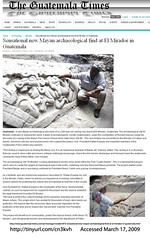
Popul Vuh carving found at El Mirador

 
Archeologists have found a 2200 year old carving in Guetamala that appears to show a scene from the Popol Vuh
(the Mayan creation myth), according to Guatemala News.  Richard Hansen, whose team found the carving, compares it to the Mona Lisa.   The carving is in a structures (sic) that was used to store water and shows a Mayan mythological passage, where the twin heroes Ixbalanque and Hunacpú leave the underworld carrying the head of their father, Hun Hunapú.
Supposedly El Mirador is going to be part of the largest archeological park in the world, called Cuatro Balam (Fourth Jaguar?), which will include over 4,000 pyramids.  That's pretty cool.
Popol Vuh discovery at El Mirador


(picture source=article source; screenprint of original)

Friday, December 12, 2008

Mystery pyramid built by newfound ancient culture in Mexico


An ancient pyramid located not far from Mexico City may be the product of a previously unknown pre-Colombian culture, according to National Geographic
Most of the 41 artifacts "do not fit into any of the known cultures of the Valley of Tulancingo, or the highlands of central Mexico,"said Carlos Hernández, an archaeologist at Mexico's National Institute of Anthropology and History in the central state of Hidalgo. .... Many of the figures are depicted in a sitting position, with their hands placed on their knees. Some have headdresses or conical hats with snakes at the base, which could represent Ehécatl-Quetzalcóatl, the Aztec god of the wind. One figure shows a man emerging from the jaws of a jaguar.
The sculptures are also made of flat stucco—a combination of fine sand, lime, and water—and painted blue or green to the give the appearance of jade. All of the artifacts date to the Epiclassic period between A.D. 600 to 900. ...
But by linking all the characteristics that make them different, [such as their location in Tulancingo and time period], allows us to say that they should be considered as a product of a different culture [called Huajomulco]....
The pyramid's proportions, along with smaller structures that were painted black and white, do not correspond to the Toltec or Teotihuacan cultures of the same area and time period.
I wonder how long it will be before people who have no clue will be talking about human sacrifice and calendars ending in conjunction with this new culture?

(Screenprint of original article)
12.19.15.16.10 13 Mac 3 Oc (burner day)

Friday, July 04, 2008

Mystery cave under Mexican pyramid


Archaeologists are currently excavating a cave under the Pyramid of the Sun at Teotihuacan outside of Mexico city.
The cave was originally found 30 years ago, but was closed up almost immediately, and the archaeologist who discovered died shortly afterward.
"We think it had a ritual purpose. Offerings were placed at the very end of the tunnel as part of the pyramid's construction process," Mexican archaeologist Alejandro Sarabia told Reuters.
"We want to find out why the Teotihuacan people sealed it and when," he said.
12.19.15.8.9 12 Tzec 11 Muluc
(screenprint; image source=article source)

Monday, August 06, 2007

Aztec pyramid found

According to this article, one of the many pyramids destroyed by Cortez and his merry band has been unearthed in Mexico city:
Archaeologists have discovered what they think are ruins of an Aztec pyramid razed by vengeful Spanish conquerors in what is now one of Mexico City's most crime-ridden districts.
Construction workers unearthed ancient walls in the busy Iztapalapa neighborhood in June, and government archeologists said Wednesday they believe they may be part of the main pyramid of the Aztec city, destroyed by conquistador Hernan Cortes in the 16th century.
"The main pyramid"? What the Spanish called the Temple Mayor? I thought they already found that--in 1978. The pyramid couldn't be so big that they'd find another piece of it far away. I tried to find a map of Mexico City showing all the various ruin sites, but they were all lame or not functional.
12.19.14.9.16 4 Yaxkin 3 Cib